Traditional Irish Music, Dingle Sessions, Poetry

Showing posts with label Harmonica. Show all posts

23 February 2009

Scoil Cheoil an Earraigh

Scoil Cheoil an Earraigh 2009 took place from February 18 to 22 in the village of Ballyferriter which is a few miles west of Dingle.

Musical offering on opening night

Scoil Cheoil an Earraigh is a Traditional Music School which concentrates on the style of music and song from the Dingle Peninsula gaeltacht of Corca Dhuibhne. 2009 was the fifth year for the school. The participants were all ages and many of them were young.


The following classes were offered:
Harp Deirdre Grainbhéal
Accordion Breanndán Ó Beaglaoich & Eoin Ó Beaglaoich
Bodhrán Colm Murphy
Banjo & Mandolin Des Kelliher
Uileann Pipes Cillian Ó Briain
Fiddle Úna Ní Chíosáin & Caoimhín Ó Raghallaigh
Tin Whistle Bríd Donnelly
Flute Aoife Grainbhéal
Concertina Cormac Ó Beaglaoich & Mary McNamara
Bag Pipes Allan MacDonald
Mouth Organ Rick Epping
Sean-nós Dancing Róisín Ní Mhainín
Singing in the sean nós style Aine Uí Laoithe, Muireann Nic Amhlaoibh

In addition master classes were given by Mary McNamara on concertina, Mary Bergin on tin whistle and Mick Mulcahy on box.

Rick Epping & his merry men
The Harmonica, Mouth Organ was a new addition this year and I was very happy to participate in the lessons. The teacher, Rick Epping is an American who has spent many years Ireland. He worked for Hohner for a number of years and it was he who designed the Hohner XB40 harmonica. The participants were all older men like myself. There is altogether very little interest in the harmonica in traditional Irish circles now-a-days. Rick Epping may well change that; everyone at the event was very impressed with his playing.

I was delighted that we did not spend all of our time learning tunes as is often done. Rather, Rick spent time explaining the instrument, demonstrating techniques and teaching us how to play in a better way. We learned how to bend notes and how to play an octave by blocking two holes with the tongue.

My daughter, Deirdre took part in the sean nós singing and she was delighted with it. It was all in Irish and it was in the old style(sean nós.)

There were concerts on Friday and Saturday evenings and there were lots of informal sessions that went on into the night. I joined the one at Hotel Óstán Cheann Sibéalhotel. It was lead by John FitzGerald on box with his wife Mary on keyboard and children Sean on fiddle, Kieran on concertina and Aine also on concertina. This is a very talented family from Kildare and I was delighted to spend the night with them. A number of other musicians also joined in as the night went on. This session as well as some of the others went on until the small hours of the morning.

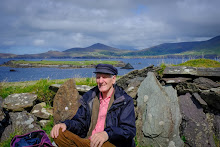
Outdoor session on final day


18 December 2006

Harmonica and Traditional Irish Music

The harmonica is the world’s best-selling musical instrument. It is inexpensive, easy to carry around and it is suitable for many different kinds of music, from blues to rock to folk and even classical music.

Back in Cork in the 40’s and 50’s, whenever people got together for a social event it was inevitable that there would be singing and music. Often somebody would pull a harmonica out of his pocket and sometimes that person was me.

There was lots of music in our house since I grew up in a family of fiddle players. There was my grandfather who would have played with a Slíbh Luchra style being from Kishkeam which is in the North-west corner of County Cork. He would hold the fiddle very low on his chest and played with a great lilt and was very strict about rhythm. He often told me how he learned from his father. My father played too and my older brother played very well. The tradition is being carried on by my son Kieran who can be heard now and then in the sessions in Dingle. That makes five generations.

To participate in a session you need to have at least two diatonic harmonicas, a ‘G’ and a low ‘D’. I tried using a chromatic harmonica and found it difficult since there are too many draw notes for the above mentioned keys and I got out of breath. There is one problem to be overcome with the ‘G’ if you have the standard 10 hole model and that is-there is no low ’E’. You can however modify it. For instructions on how to make the modification go to the website of Steve Shaw
and click on “Tuning-A Big Issue”. Steve does a great job of explaining all you things you need to know harmonicas for session playing so I will leave that to him.

I go out to play in the sessions in Dingle a couple of times a week. When I first started, four years ago, I destroyed a harmonica every two to three weeks. That was when I consulted Steve Shaw who pointed out that a harmonica has to be blown softly. He recommended using an amplifier. From then on I had no further trouble with the destruction of the instruments. However, amplifiers are not always welcome at the sessions. They had to put up with me until I discovered a new type of harmonica developed by Hohner USA called the XB-40. Pat Missin
has a good review on the product.


XB-40 was made especially for musicians that wanted to bend the notes. It is, however, also much louder than other harmonicas. For the past six months or so I have been able to manage without the amplifier and without destroying the instruments. XB-40 is available in several keys including the essential ones for Irish music namely, 'G' and 'lowD'. The cost is about $80 in the US and about £48 by mail order from England. I frequently use Harmonicas Direct in the UK ; they have good service and reasonable prices.

Technorati Tags:

Home Session with daughter Deirdre

Topics

Irish Blog Directory

Blog Archive

Site Meter